
How Home Solar Panels Work
A residential solar system is a chain of straightforward steps: sunlight becomes DC electricity, an inverter converts it to AC, your home uses what it needs, and the rest is stored or sent to the grid. Here's each link in that chain.
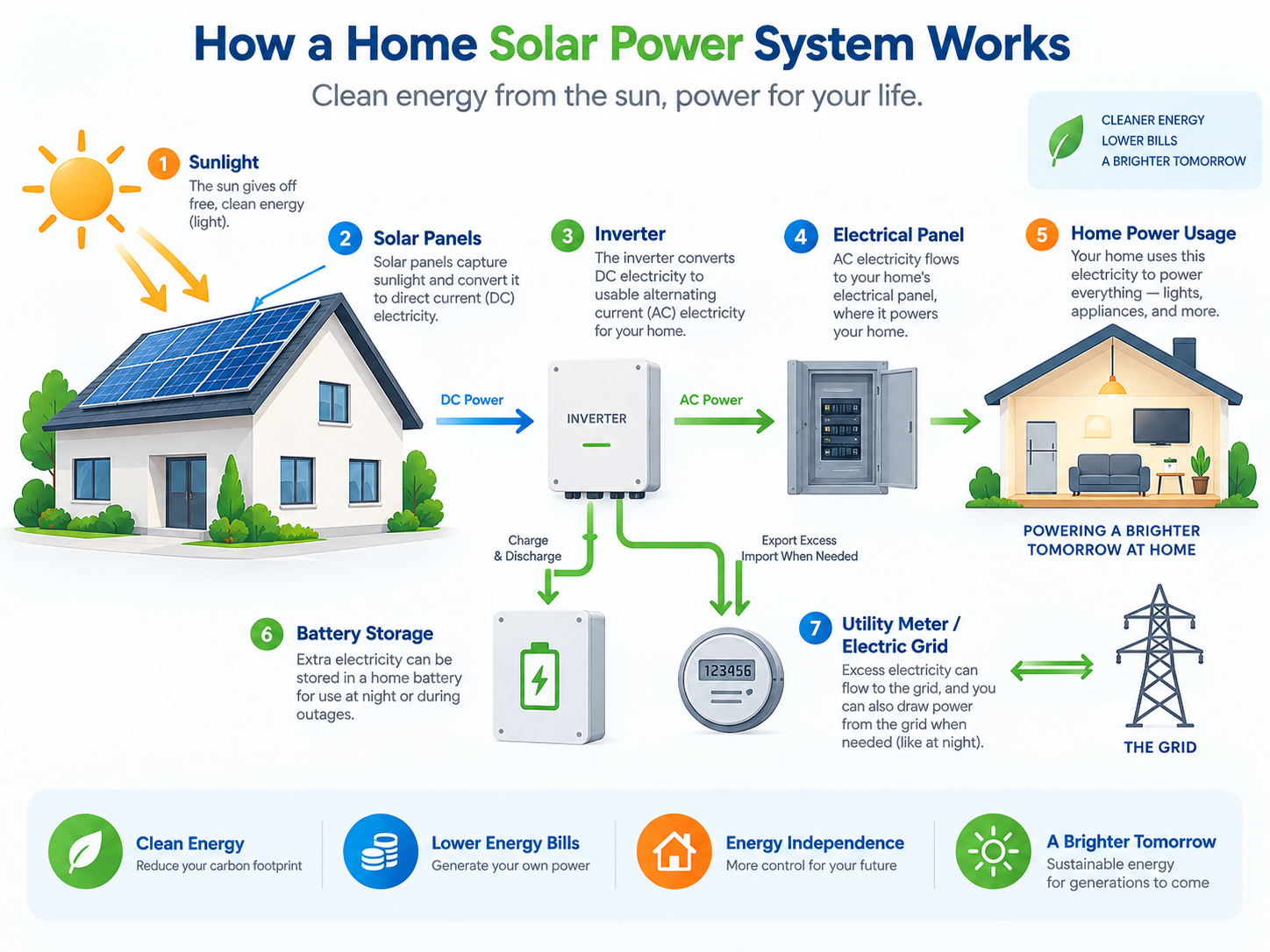
The path electricity takes from a rooftop panel to a light switch in your home involves several distinct steps, each handled by a specific piece of equipment.
1. Solar Generation at the Panel
Photovoltaic cells inside each solar panel generate direct current (DC) electricity when sunlight strikes them. Panels are wired together in series or parallel groups, called strings, to combine their output into a single DC circuit that runs to the inverter. The amount of electricity generated at any moment depends on sunlight intensity, panel angle relative to the sun, temperature, and whether any part of the array is shaded.
2. DC Electricity
DC electricity flows in one direction and is the natural output of a photovoltaic cell. It's the same type of current produced by a battery. DC power from the array is not directly usable by most household circuits, which is why the next step in the chain exists.
3. The Inverter
The inverter converts DC electricity from the panels into alternating current (AC) electricity, the type of power used by the grid and by virtually all home appliances and outlets. Depending on system design, this conversion happens at a single central inverter for a whole string of panels, or at each individual panel with microinverters. See solar inverter installation for how that choice is made.
4. AC Electricity
Once converted, the electricity is in the same form supplied by the utility grid and can be used directly by your home's circuits, lighting, appliances and outlets, or exported to the grid, or directed to a battery for storage, depending on system configuration and real-time demand.
5. The Electrical Panel
AC power from the inverter is connected into your home's main electrical panel, typically through a dedicated breaker. This is the point where solar-generated electricity and utility-supplied electricity combine into a single supply for your home's circuits — from a wiring standpoint, your outlets and appliances don't distinguish between the two sources.
6. Home Consumption
Electricity is used by your home in real time as it's generated, drawing first from whatever the solar system is producing at that moment, with any shortfall automatically supplied by the grid (or a battery, if installed and configured for that purpose).
Curious how this would work on your specific roof?
A site assessment maps out panel placement, expected production and how the pieces above would be configured for your home.
7. Battery Storage (Optional)
If a battery is part of the system, excess electricity generated beyond what the home is using at that moment can be stored for later use — in the evening, overnight, or during a grid outage if the system includes backup capability. Without a battery, excess electricity is exported rather than stored on site. Our battery storage page covers the equipment involved.
8. Grid Imports
When your home needs more electricity than the solar system is currently producing — at night, on a cloudy day, or during high usage — the difference is drawn from the electric grid automatically, exactly as it was before the system was installed.
9. Grid Exports
When the system produces more than the home is using and there's no battery to store it (or the battery is full), the excess flows out to the grid. How that exported electricity is credited or compensated depends entirely on your specific utility's policy — see our page on tax credits and incentives for the general categories involved and where to verify current utility rules.
10. Monitoring
A monitoring system, usually an app or web dashboard connected through a gateway device, reports how much electricity the system is producing, either for the system as a whole or panel by panel with microinverters. Monitoring is how most homeowners and installers notice a drop in output that might indicate shading, a fault, or the need for cleaning or inspection.
Key Components in a Home Solar System
- Solar panels — generate DC electricity from sunlight.
- Racking and mounting hardware — secure panels to the roof structure.
- Inverter (string, micro or hybrid) — converts DC to usable AC electricity.
- Rapid shutdown and disconnects — required safety equipment for the array.
- Electrical panel connection — where solar and utility power combine.
- Battery (optional) — stores excess electricity for later use or backup.
- Monitoring gateway — reports production data over time.
- Utility meter and interconnection — governs how exports are measured and credited.
How Solar Works FAQs
What actually generates electricity in a solar panel?
A solar panel is made of photovoltaic cells that generate direct current (DC) electricity when sunlight strikes them. Individual cells are wired together into a panel, and panels are wired together into an array. The array's total DC output depends on how much sunlight reaches the cells, the panels' orientation, and their temperature.
Why does a home need an inverter if panels already make electricity?
Homes and the electric grid run on alternating current (AC), while solar panels produce direct current (DC). An inverter converts the array's DC output into AC electricity that your home's outlets, appliances and electrical panel can actually use. Without an inverter, the panels' output isn't usable by standard household equipment.
What's the difference between a string inverter and microinverters?
A string inverter converts DC to AC for a whole group, or 'string,' of panels at once, usually mounted near the electrical panel. Microinverters perform that conversion at each individual panel. Microinverters can allow better performance when some panels are shaded and provide panel-level monitoring, while a string inverter is often simpler and can cost less for straightforward, unshaded roofs. See our page on inverter installation for more detail.
What happens to solar electricity once it reaches my electrical panel?
The electrical panel is the point where AC power from the inverter joins the electricity supplied by your utility. From there, it's distributed to your home's circuits the same way utility power always was — your appliances and outlets don't distinguish between solar-generated and utility-supplied electricity once it reaches the panel.
What happens when my panels produce more electricity than my home is using?
Excess AC electricity generally flows out through your electrical panel and meter to the electric grid, a process called exporting. Depending on your utility's specific policy, you may receive a credit or compensation for that exported electricity — arrangements vary by provider, so check with your utility directly, or see our page on tax credits and incentives for the general categories involved.
What happens on a cloudy day or at night?
Panel output drops with reduced sunlight and stops at night. When your system isn't producing enough to cover your home's usage, the difference is drawn from the grid automatically, the same way it always was before solar was installed — unless you have battery storage configured to supply that gap instead.
What does a battery add to this system?
A battery stores excess DC or AC electricity (depending on system design) generated during the day for use later, such as in the evening or during a grid outage, if the system is configured for backup. Without a battery, any electricity not used immediately is simply exported to the grid rather than stored on site. See our page on battery storage for how that equipment integrates with the rest of the system.
How do I know how much electricity my system is producing?
Most residential systems include a monitoring gateway or app that reports production data, either at the whole-system level (typical with a string inverter) or at each individual panel (typical with microinverters). This lets you track output over time and can help identify a problem, such as underperformance from shading or a fault, sooner rather than later.
Related Solar Resources
- Solar Panel InstallationHow this equipment is actually installed on a roof.
- Solar Inverter InstallationString, micro and hybrid inverters compared.
- Solar Battery StorageHow stored power and backup circuits work.
- Is My Roof Good for Solar?Roof factors that affect where panels can go.
- Solar Panel Cost in Laredo TXHow each component affects your quote.
Ready to see how this applies to your home? Request a solar quote or call 956-395-1662.
Ready to Explore Solar for Your Property?
Start with a quick quote request and provide a few details about your property and current electricity use.