
Residential Solar Laredo TX
A residential solar project fits a photovoltaic system to a specific house — its roof, its electrical panel and its electricity use — rather than dropping in a one-size-fits-all package.
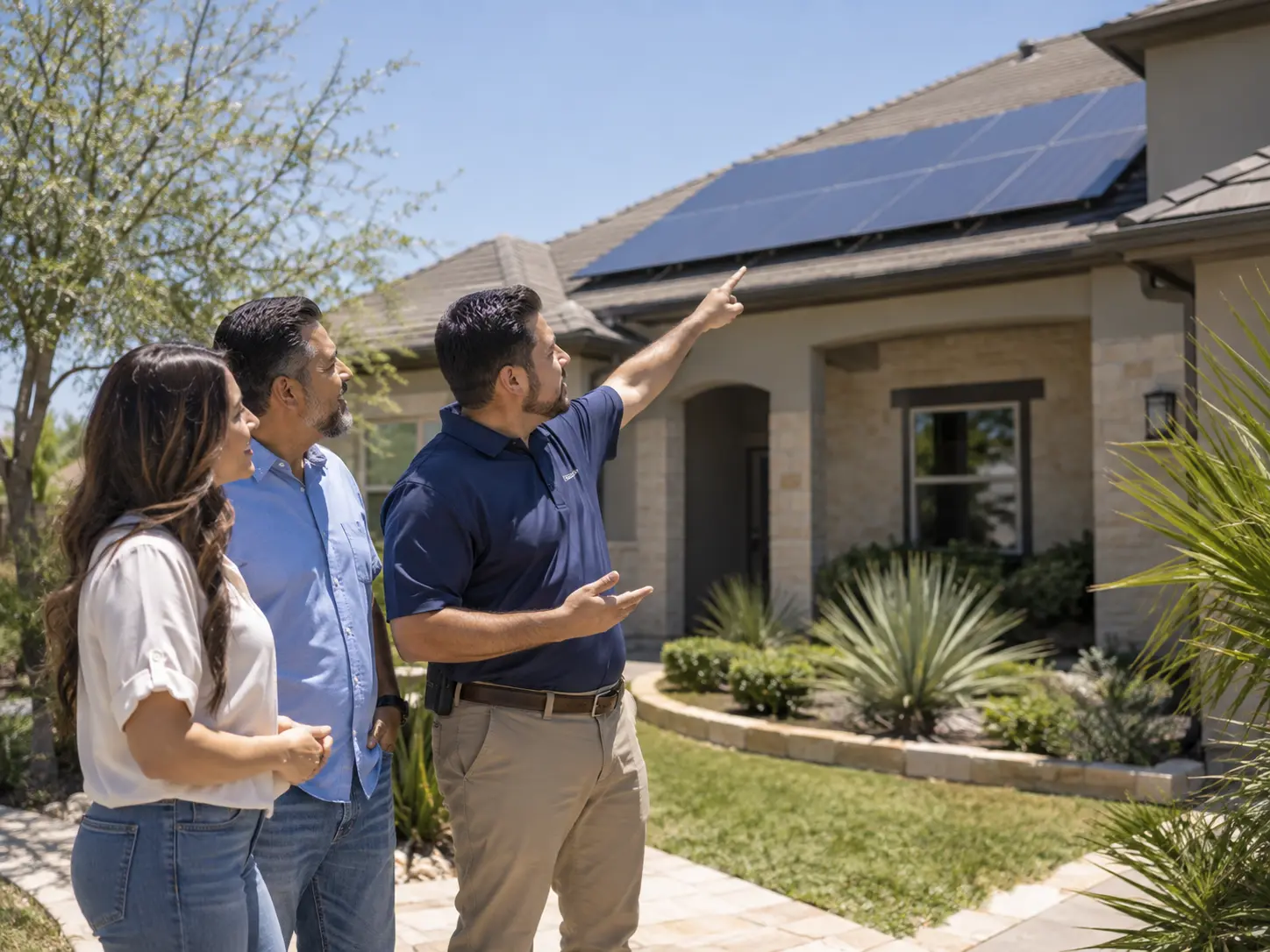
Home solar starts with a household's actual electricity habits, not a generic template. A single-story home with modest usage needs a different system than a larger house running electric vehicle charging, a pool pump or a home office with added HVAC load. Getting the sizing right up front avoids paying for capacity you won't use, or ending up with a system too small to matter.
The starting point is usually the same for every homeowner: twelve months of utility bills showing kilowatt-hour usage, a look at the roof's orientation and condition, and a walk-through of the electrical panel. From there, a designer works out array size, module count and inverter type. For the mechanics of putting that design on the roof, see our page on solar panel installation.
Why Homeowners Consider Residential Solar
- To reduce the portion of monthly electricity bought from the utility.
- To lock in a known project cost instead of an electricity bill that moves with rates and usage.
- To prepare for added household load, such as an EV charger or a new HVAC system.
- To pair generation with a battery for backup power during outages.
- To generate electricity on site without combustion or fuel delivery.
What's Typically Involved for a Home
- Usage review. Twelve months of utility bills in kilowatt-hours, plus any known upcoming changes in household electricity use.
- Roof and shading assessment. Orientation, pitch, roof covering, age and shading across the day and seasons.
- Electrical panel review. Confirming available capacity and whether panel work is needed before interconnection.
- System design. Array layout, module count, inverter selection, and whether battery storage is part of the plan.
- Permitting and interconnection. Local permit application and a utility interconnection request specific to residential service.
- Installation and activation. Rooftop work, inspection, and utility authorization before the system is energized.
Ready to size a system around your household's actual usage?
Send your utility bills, roof type and any planned changes like EV charging, and get a home-specific quote request started.
Equipment Used in Home Systems
- Residential-scale modules. Standard panel sizes designed for pitched or low-slope residential roofs.
- String or microinverters. String inverters suit uniform, unshaded roofs; microinverters handle multiple roof planes or partial shading better.
- Roof-specific racking. Attachment hardware matched to shingle, tile, metal or membrane roofing.
- Monitoring app or portal. Lets a household track daily and monthly production.
- Optional home battery. Stores daytime production for evening use or outage backup — see solar battery storage.
Factors That Affect Cost for a House
- Household electricity usage and the resulting system size in kilowatts.
- Roof covering, pitch and the number of separate roof planes used.
- Shading conditions and whether microinverters are needed to manage them.
- Electrical panel condition and whether an upgrade is required.
- Whether a battery and backup subpanel are included.
- Distance from the array location to the inverter and electrical panel.
For a full breakdown of every cost variable, see solar panel cost in Laredo, or model your own numbers with the solar savings calculator.
Questions to Ask a Residential Solar Provider
- How did you calculate my recommended system size?
- Which roof planes are you using, and why those over others?
- What inverter type do you recommend for my roof, and why?
- Does my electrical panel need work before interconnection?
- Is battery storage compatible with this design if I add it later?
- What monitoring will I have access to after activation?
Information to Have Ready
- Twelve months of utility bills showing kilowatt-hour usage.
- Roof age and covering type.
- A photo of your electrical panel label and available breaker slots.
- Any plans for EV charging or major appliance additions.
- Notes on trees or structures that shade the roof.
- Whether backup power during outages matters to your household.
How a Home Solar Project Runs
- Step 1
Usage review
Utility bill analysis and a conversation about your household's electricity habits.
- Step 2
Site visit
Roof, shading and electrical panel assessment at your property.
- Step 3
Design and quote
An itemized proposal with system size, equipment and total price.
- Step 4
Install and activate
Permitting, interconnection, rooftop work, inspection and utility approval.
Ready to compare solar options for your property?
Share a few details about your roof and current electricity use to start a property-specific quote request.
Residential Solar FAQs
How much of my home's electricity can solar realistically offset?
Offset depends on your roof's usable area, orientation, shading and your annual electricity use in kilowatt-hours. A well-sited south- or west-facing roof section with minimal shading can offset a large share of typical household use, while a small or heavily shaded roof may only offset part of it. Twelve months of utility bills give a designer the usage data needed to size a system realistically.
Does my roof orientation matter that much?
Yes. South-facing planes generally see the most sun across the day in Texas, but east- and west-facing roof sections still produce meaningful electricity and are commonly used when south-facing area is limited. North-facing roof planes are the least productive and are usually avoided unless no other option exists.
Can I add a battery later instead of at initial installation?
Often yes, especially with hybrid or battery-ready inverters designed for it. Confirm inverter compatibility and available capacity before installation if you think you might add a battery later, since some string inverter setups make a later addition more complex than including one at the start.
What size system does a typical Laredo home need?
System size is calculated from your household's annual kilowatt-hour usage, not a generic per-home number. A home with electric vehicle charging or a pool pump uses meaningfully more electricity than one without, and system size should reflect your actual usage pattern, not an assumption.
Will solar work if my roof has some shading from trees?
Partial shading reduces production from the shaded modules and, depending on inverter type, can affect a whole string. Microinverters or power optimizers limit shading's impact to the individual module. A site assessment should map shading across the day and seasons, not just at one moment.
How does my home's electrical panel affect the project?
The panel is the interconnection point for the solar circuit. Panels that are older, undersized, or already near their rated capacity sometimes need a busbar upgrade or a full panel replacement before solar can be added. This is confirmed during the site assessment from the panel's label and available breaker space.
Related Solar Resources
- Solar Panel InstallationHow a designed system becomes a working array.
- Solar Battery StorageBackup power and storing daytime production.
- Is My Roof Good for Solar?Orientation, shading, pitch and roof condition.
- Solar Panel Cost in Laredo TXEvery variable that moves a residential quote.
- Solar Savings CalculatorModel production, offset and savings.
Ready to size a system for your home? Request a solar quote or call 956-395-1662.
Ready to Explore Solar for Your Property?
Start with a quick quote request and provide a few details about your property and current electricity use.