
Solar Inverter Installation Laredo TX
The inverter converts the direct current your solar array produces into the alternating current your home or business uses — and the type you choose affects shading tolerance, monitoring detail and future battery compatibility.
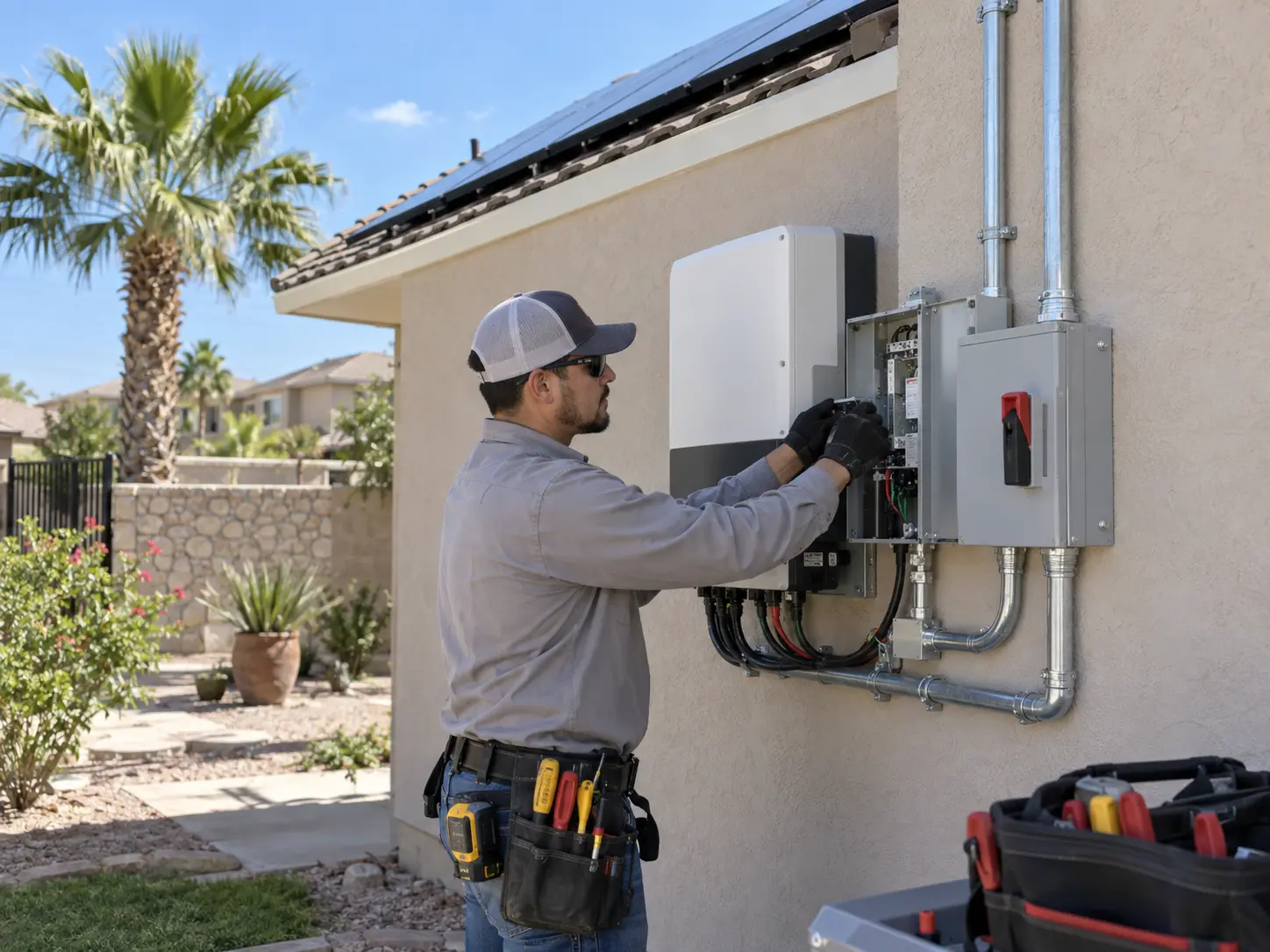
Every grid-connected solar array needs an inverter — there's no way around it, since panels generate DC electricity and homes, businesses and the utility grid all run on AC. What varies is which inverter architecture is used: a single string inverter serving a whole array, microinverters at each module, or a hybrid inverter that also manages battery charging.
The choice affects more than conversion efficiency. It shapes how shading impacts total production, what level of per-module monitoring you get, and how straightforward it is to add battery storage later. This decision is usually made during system design, before installation begins.
Why Inverter Choice Matters
- To manage shading from trees, chimneys or neighboring structures without losing a whole string's output.
- To get per-module production monitoring instead of only whole-array totals.
- To keep future battery storage straightforward with a compatible inverter architecture.
- To match equipment to roofs with multiple planes facing different directions.
- To replace an aging or underperforming inverter on an existing system.
What Inverter Installation Involves
- Architecture selection. Choosing string, microinverter or hybrid based on roof layout, shading and storage plans.
- Mounting location. A shaded, ventilated wall location for string and hybrid units; under-module mounting for microinverters.
- DC wiring. Connecting module strings or microinverter trunk cables per the design.
- AC connection. Wiring the inverter output to a disconnect and the electrical panel.
- Rapid shutdown integration. Ensuring the inverter setup meets rapid-shutdown requirements for the array.
- Commissioning. Powering on, configuring monitoring, and verifying production readings before inspection.
Deciding between string, micro or hybrid inverters?
Tell us about your roof layout, shading and whether battery storage is part of the plan, and we'll help match equipment to your project.
Inverter Types Compared
- String inverters. Cost-effective for simple, unshaded, single-orientation roofs; one unit serves many panels.
- Microinverters. Better suited to shaded roofs, multiple roof planes, or when module-level monitoring is a priority.
- Power optimizers with a string inverter. A middle option — module-level optimization feeding into a central string inverter.
- Hybrid inverters. Manage solar and battery charge/discharge in a single unit for storage-ready systems.
Factors That Affect Inverter Cost
- Inverter architecture chosen — string, microinverter or hybrid.
- Total system size in kilowatts and the number of modules needing coverage.
- Whether the project includes battery integration requiring hybrid capability.
- Complexity of the roof layout and number of orientations involved.
- Whether this is new installation or a replacement of existing inverter equipment.
Questions to Ask About Inverter Selection
- Why is this inverter architecture recommended for my specific roof?
- How will shading on part of my roof affect production with this inverter type?
- Does this inverter support adding a battery later without replacement?
- What monitoring detail will I have — whole-array or per-module?
- Where will the inverter be mounted, and how will it be ventilated?
- What is the manufacturer's stated product coverage period for this model?
Signs an Existing Inverter May Need Attention
- Error codes or fault lights on the inverter display.
- A noticeable drop in reported production without a change in weather or shading.
- Unusual noise, heat or discoloration around the unit.
- Monitoring app showing the system offline or not reporting data.
- The inverter is well beyond its stated service expectations for the model.
How Inverter Installation Fits the Project
- Step 1
Design
Inverter type selected based on roof, shading and storage goals.
- Step 2
Mounting
Wall-mounted unit or under-module microinverters installed with the array.
- Step 3
Wiring
DC connections from modules, AC connection to the electrical panel.
- Step 4
Commissioning
Power-on, monitoring setup, inspection and interconnection approval.
Ready to compare solar options for your property?
Share a few details about your roof and current electricity use to start a property-specific quote request.
Solar Inverter Installation FAQs
What does an inverter actually do?
Solar modules produce direct current (DC) electricity. An inverter converts that DC output into alternating current (AC), which is the form of electricity used by household and business circuits and delivered by the utility grid. Without an inverter, the DC power your panels generate can't be used by standard electrical loads or exported to the grid.
What's the difference between a string inverter and microinverters?
A string inverter is a single unit that converts DC to AC for a whole string of panels wired together, typically mounted near the electrical panel. Microinverters are small units mounted at each individual panel, converting DC to AC at the module level. Microinverters isolate the impact of shading or a failing module to that one panel; a string inverter's output for the whole string can be affected by a single shaded or underperforming module.
What is a hybrid inverter?
A hybrid inverter manages both solar production and battery charging and discharging in one unit, rather than requiring a separate inverter for storage. Hybrid inverters are commonly used when battery storage is part of the project from the start, since they simplify the DC-to-AC-to-battery power flow into one piece of equipment.
How long does inverter installation take?
Mounting and wiring a string inverter is typically a same-day task as part of a larger installation. Microinverters are installed panel by panel during the rooftop work itself, adding time to the module installation phase rather than being a separate step. Either way, the system still needs inspection and utility interconnection approval before it's energized.
Do inverters need to be replaced over time?
Inverters are electronic equipment and are commonly replaced at least once during a solar array's service life, since they generally have shorter expected service lives than the modules themselves. Ask your provider what the manufacturer's stated product coverage period is for the specific inverter model being installed.
Where is an inverter typically mounted?
String and hybrid inverters are usually mounted on an exterior or garage wall near the main electrical panel, in a shaded, ventilated location to manage operating temperature. Microinverters are mounted under each module on the racking itself, out of direct view.
Related Solar Resources
- Solar Panel InstallationHow the full system comes together on the roof.
- Solar Battery StorageHybrid inverters and backup power.
- Solar Panel RepairDiagnosing inverter faults and production drops.
- Solar Panel Cost in Laredo TXHow equipment choices affect total price.
- Solar Savings CalculatorModel production, offset and savings.
Have inverter questions for your project? Request a quote or call 956-395-1662.
Ready to Explore Solar for Your Property?
Start with a quick quote request and provide a few details about your property and current electricity use.